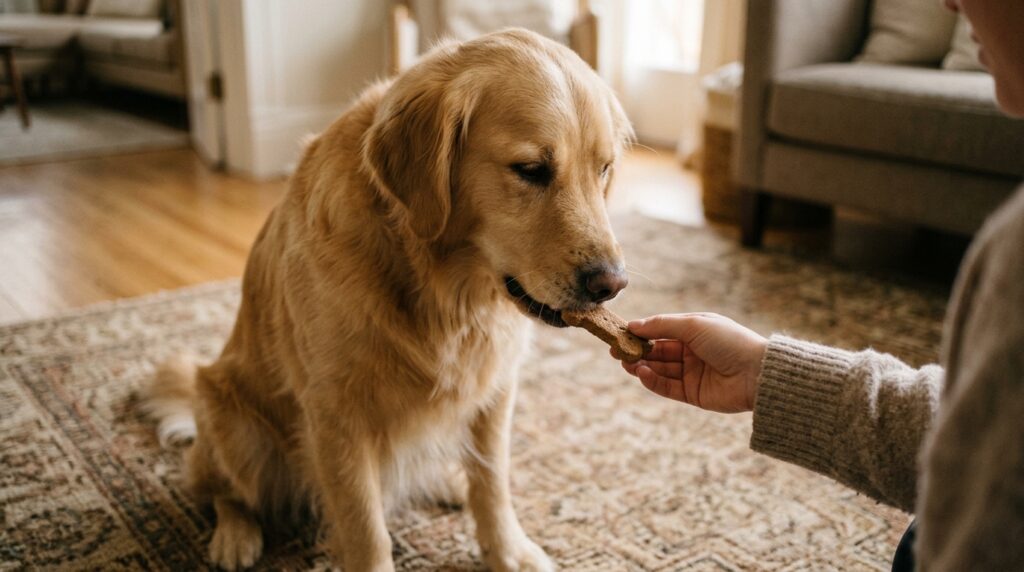
Every treat in a dog’s bowl has a supply chain behind it. Grain gets harvested, meat gets processed, oil gets pressed, and somewhere along the way a recipe turns raw material into something a dog will sit and wait for.
Hemp-infused products add extra links to that chain. CBD dog treats are a good example of how many decisions hide behind a small biscuit, from the seed in the ground to the number printed on the bag. Following one treat from field to bowl shows where quality gets built in and where it can slip.
The route below covers farming, extraction, the biology behind the interest in cannabidiol, baking, and testing, with the rules and checkpoints that apply at each stop.
Starting in the Field
What Counts as Hemp
Hemp and marijuana come from the same species, Cannabis sativa, and the legal line between them is a number. The Agriculture Improvement Act of 2018, known as the 2018 Farm Bill, defines hemp as cannabis with no more than 0.3 percent delta-9 THC on a dry weight basis. Anything above that falls back under the federal definition of marijuana.
The U.S. Department of Agriculture turned that rule into a licensing program. Under its final rule, which took effect in 2021, growers must have a crop sampled shortly before harvest, within 15 days, and the sample must be tested by a laboratory registered with the Drug Enforcement Administration. A crop that tests over the limit cannot enter the supply chain as hemp.
Why Soil Matters
Hemp is a hungry plant. Researchers have studied it as a tool for cleaning polluted land, because it draws metals and other contaminants out of the ground as it grows. That trait is useful for remediation and a problem for food. A field with a history of industrial use or heavy pesticide application can pass compounds into the plant, and from the plant into an extract.
For that reason, careful producers keep records of where the hemp was grown and test the soil, the plant material, or both. A treat that ends up in a dog’s mouth inherits whatever the field handed over.
Pulling Out the Compounds
A Short History
Cannabidiol is not new. Chemist Roger Adams isolated it at the University of Illinois in 1940. The structure was worked out in 1963 by Raphael Mechoulam and Yuval Shvo at the Hebrew University of Jerusalem, and Mechoulam’s group described THC the following year. For decades the compound stayed in laboratories. The interest grew after the FDA approved Epidiolex, a purified CBD medicine for certain seizure disorders in people, in 2018, the same year the Farm Bill passed.
Those two events pushed CBD into shops, and the animal market followed. The FDA has not approved any CBD product for pets, and its Center for Veterinary Medicine has said it cannot vouch for the safety or effectiveness of those sold for them.
How Extraction Works
Hemp flowers hold the compounds in tiny resin glands. Getting them out takes a solvent. Two methods dominate.
- Supercritical CO2 extraction uses carbon dioxide under high pressure, where it behaves like both a gas and a liquid. Pressure drops at the end, the CO2 leaves as a gas, and the extract remains.
- Ethanol extraction soaks the plant in food-grade alcohol, which is then evaporated away.
Other solvents, such as butane or hexane, exist in the industry, and residual traces are a reason to ask for a solvent screen on the lab report. The raw extract then gets refined. Producers can leave it as a full-spectrum oil, strip the THC to make a broad-spectrum oil, or purify the CBD to form a white crystalline isolate.
Why a Dog’s Body Responds
The Endocannabinoid System
Mammals carry a signaling network called the endocannabinoid system. Researchers identified the first cannabinoid receptor, CB1, in the late 1980s, with work led by Allyn Howlett and William Devane. A second, CB2, followed in 1993. In 1992 Devane and Mechoulam’s group reported anandamide, a compound the body makes itself that fits the same receptors. The system touches pain signaling, appetite, mood, immune activity, and more.
Dogs have it too, which is why THC hits them so hard and why veterinarians see intoxication cases after dogs eat edibles. CBD works differently. It does not bind tightly to CB1, and scientists are still sorting out how it acts, with candidates ranging from effects on other receptors to changes in how the body breaks down its own cannabinoids. That gap in knowledge is the reason claims about dosing and results deserve caution.
What the Dog Studies Show
Research is thin. A Cornell University team reported in Frontiers in Veterinary Science in 2018 that dogs with osteoarthritis given CBD oil at 2 mg per kilogram of body weight twice daily for four weeks showed lower pain scores and more activity than on placebo. A Colorado State University group reported results in the Journal of the American Veterinary Medical Association in 2019 from 26 dogs with epilepsy over 12 weeks, and the findings were mixed. Both studies were small, and both used oil, not baked treats.
From Extract to Biscuit
A recipe is a chemistry problem in disguise. The extract has to be mixed evenly into the dough or filling, since uneven mixing means one treat holds more CBD than the next. Cannabinoids can break down with heat, light, and air over time, so bakers watch oven temperatures, and packaging often uses opaque pouches.
| Stage | What happens | What to check |
|---|---|---|
| Growing | Hemp is grown, sampled, and tested for THC | License, THC compliance |
| Extraction | Solvent pulls compounds out | Method, residual solvent results |
| Formulation | Extract goes into a base | Ingredient list, no xylitol |
| Baking or forming | Treats are cooked or pressed | Even distribution of CBD |
| Testing | Finished batch is analyzed | Certificate of analysis |
| Packaging | Treats are sealed and labeled | Milligrams per treat, best-by date |
The base matters as much as the hemp. A treat built on chicken, pumpkin, or oat flour has its own calorie count, allergen profile, and shelf life. Veterinarians commonly advise keeping all treats under 10 percent of a dog’s daily calories, and a hemp treat counts toward that total.
Checking the Finished Product
A label states what the maker intends. A certificate of analysis (COA) states what a lab found. The two should agree. The best reports come from laboratories accredited to ISO/IEC 17025, the international standard for testing labs, and list CBD and THC in milligrams, along with results for heavy metals, pesticides, residual solvents, and microbes.
The gap between label and lab is real. A 2017 study in JAMA, led by Marcel Bonn-Miller, tested 84 CBD products sold online and found that about 26 percent held less CBD than labeled and about 43 percent held more. THC appeared in roughly 21 percent. Those were products for people, yet the lesson carries over, since a printed number proves nothing without a lab behind it.
The National Animal Supplement Council runs a quality seal program for pet supplements, which involves facility audits and adverse event reporting. A seal does not replace a batch report, but it adds a layer of outside review.
Short FAQ
Is hemp the same as marijuana?
Both are Cannabis sativa. Federal law sets hemp apart as cannabis with no more than 0.3 percent delta-9 THC by dry weight.
Do all CBD treats contain THC?
No. Full-spectrum products carry trace amounts, while broad-spectrum and isolate products have THC removed or never contain it. The lab report shows the actual figure.
What does CO2 extraction mean for the treat?
It describes how the hemp compounds were pulled from the plant. The method leaves no liquid solvent behind, though the report should still show a solvent screen.
Can a treat replace veterinary medicine?
No. The FDA has not approved CBD for pets, and approved options exist for conditions such as arthritis. A veterinarian can advise on both.
Final Thoughts
A CBD dog treat is the end of a chain that starts with a field and ends with a lab report, and each link can be checked. Reading the report before the treat reaches the bowl closes the loop.